Going overdrawn is rarely a surprise. It happens on a specific date: often a few days before payday, once the rent, the direct debits and the month’s shopping have gone out and the salary hasn’t arrived yet. The balance you see today doesn’t show it: it still counts the money already earmarked for the rent on the 5th and the car loan on the 20th.
What lets you see it coming is your balance over the next few days: start from today, map out what will come in and go out, and find the lowest point.
1. List what’s due on a fixed date
Go back over your last two or three statements and write down everything that recurs each month, with its date:
- money coming in: salary, pension, benefits, rent you receive;
- fixed costs: rent or mortgage, energy, phone and broadband, insurance, loan repayments, and subscriptions, which are easy to forget (see How to find and cancel subscriptions you’ve forgotten).
The date matters as much as the amount: €850 taken on the 5th or on the 30th has a very different effect on an account where the salary lands on the 28th.
Add what isn’t due every month but is coming soon: insurance paid once a year, a quarterly bill, a tax payment. Over 30 days, just one of them is enough to move the low point.
2. Estimate your everyday spending
Groceries, fuel, going out: these don’t fall on a fixed date; they trickle out a little every day. They are what’s missing when you only count fixed costs, which is why “salary minus bills” is almost always too optimistic.
To estimate them, add up this spending for each of your last full months, then take the middle value rather than the average, so one unusual month (a holiday, a big repair) doesn’t skew the estimate. With €560, €600 and €870 over three months, the middle value is €600, or about €20 a day. Small amounts often make up most of that total (see Small daily expenses: how little amounts add up to big totals).
3. Walk through the month, day by day
Start from today’s balance and move forward one day at a time: add money coming in on its date, take off fixed costs on their date, and take off each day’s share of everyday spending. What matters isn’t the balance at the end of the month, but the lowest point, and its date.
An example, with €1,350 in the account on the morning of the 1st and €20 of everyday spending a day, counted in every row:
| Date | What goes in or out that day | Balance that evening |
|---|---|---|
| 1st | — | €1,330 |
| 5th | Rent: −€850 | €400 |
| 12th | Energy and subscriptions: −€120 | €140 |
| 19th | — | €0 |
| 20th | Car loan repayment: −€230 | −€250 |
| 27th | — | −€390 |
| 28th | Salary: +€2,300 | €1,890 |
On the 1st, the account shows €1,350: nothing to worry about. Yet it reaches zero on the evening of the 19th, goes below it on the 20th with the loan repayment, and falls to −€390 on the 27th, the day before payday. That figure, and that date, are what you needed to see on the 1st.
What the low point lets you do
Known in advance, a low point leaves time to act, which you can no longer do on the day the account is already in the red. The usual options:
- Put off what can wait until after payday: a purchase, a night out, an order.
- Check your direct debit dates. Many providers (energy, phone, insurance) let you choose the day they take payment: placed just after payday rather than just before, it moves the low point without changing the amount.
- Keep that shortfall as a buffer in your current account over the following months, so you don’t dip below zero again.
- Talk to your bank before, not after, if going overdrawn can’t be avoided: the terms of an overdraft (whether it’s arranged, the limit, the fees) are specific to each bank and set out in your account terms.
The traps that keep coming back
- Only counting fixed costs. The calculation leaves out groceries and fuel, so the low point it gives is far too high.
- Looking at the end-of-month balance. It can be positive even though the account went into the red in the middle of the month.
- Forgetting what isn’t due every month: yearly insurance, a quarterly bill, back-to-school costs.
- The credit card bill. A whole month of card spending leaves your current account in one go, on a fixed date: count it as one big payment on that day.
- Doing the calculation once and for all. One unexpected expense shifts everything: redo it, especially after a big one.
30, 60 or 90 days?
Thirty days is enough to see the next dip before payday. Over 60 or 90 days, you see what isn’t due every month, and you can check the dip isn’t getting deeper from one month to the next. The longer the horizon, the more the everyday-spending estimate weighs on the result: it’s an estimate, not a certainty.
And with FinaPrism
The cash-flow forecast (Premium, with a 7-day free trial) does this calculation for you, account by account, in Tools:
- What’s due on a fixed date comes from your transactions: subscriptions and recurring payments, your salary when it arrives every month, the transactions you’ve marked as recurring (rent, for example) and your loan repayments.
- Everyday spending is estimated from your last full months: the middle value over six months at most, once you have two months of history, excluding fixed costs.
- You choose the horizon: 30, 60 or 90 days. The screen shows your current balance, the lowest projected balance, the balance at the end of the period, and flags a possible overdraft with its date.
- Two curves: fixed costs alone, and the realistic estimate that adds everyday spending. The list of upcoming flows tells you what’s due, and when.
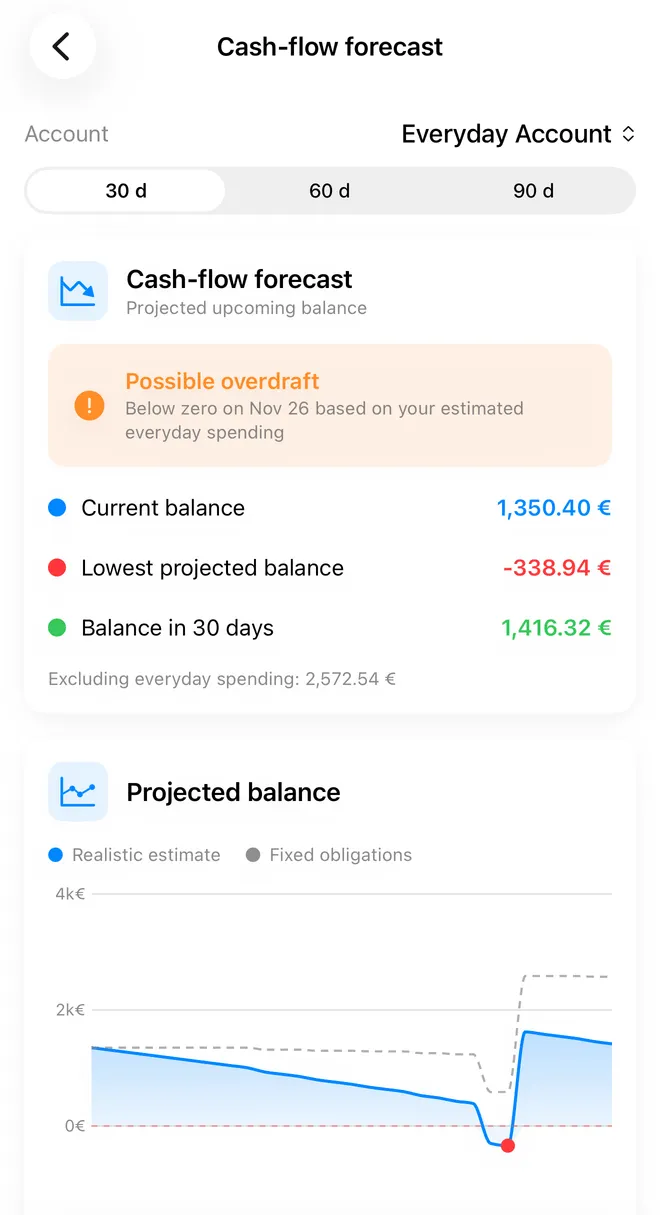 FinaPrism’s Cash-flow forecast screen (demo data).
You add your transactions by hand, or by importing your statements (also Premium): FinaPrism doesn’t connect to your bank. The forecast remains an estimate: your real balance will depend on what you actually spend. No ads, no ad tracking.