A trip next summer, driving lessons, a new laptop, a wedding. “I’d like to put some money aside for that” often stays an intention: you save whatever’s left at the end of the month, which isn’t much, and the goal gets pushed back from one season to the next.
What turns an intention into a plan comes down to three numbers: how much, by when, and so how much a month.
1. Put a price on the goal
“A trip” isn’t an amount. Break it down into what it will actually cost, using prices you’ve looked up rather than guessed, then add a buffer for the unexpected. Taking a summer trip as an example:
| Item | Amount |
|---|---|
| Travel there and back | €900 |
| Accommodation | €1,300 |
| Spending money (meals, visits, getting around) | €600 |
| Buffer for the unexpected | €200 |
| Total | €3,000 |
A precise amount has two advantages: it tells you when you’ve reached the goal, and it stops you settling for “roughly there” halfway through.
2. Give it a date
A real date (leaving in July, the start of the school year, a birthday) rather than “one day”. Then count the months between now and then. The date is the most powerful lever in the calculation: for the same amount, it decides how much effort each month takes.
| Leaving in | Months to save | Per month |
|---|---|---|
| 6 months | 6 | €500 |
| 10 months | 10 | €300 |
| 15 months | 15 | €200 |
A date that’s too far off blunts your motivation; one that’s too close gives a monthly amount you can’t keep up. The right date is the one that gives an amount you can manage every month.
3. Work out the amount per month
The calculation fits on one line:
(cost of the goal − what you’ve already put aside) ÷ number of months left
With €3,000 to reach, €600 already put aside and 8 months to go: (3,000 − 600) ÷ 8 = €300 a month. This is what’s often called a sinking fund: a known cost, spread over the months before it falls due. Redo the sum from time to time: a missed month is made up by spreading the gap over the months that follow, not by giving up.
If the amount doesn’t fit in your budget, you still have three levers: push the date back, scale the goal down, or find the money elsewhere in your spending. Small everyday amounts often hide part of it (see Small daily expenses: how little amounts add up to big totals).
4. Put the money aside at the start of the month
What’s left at the end of the month is rarely what you’d planned. The most common method does the opposite, and has a name, pay yourself first: a standing order on the day your salary lands, to a separate account, and you live on the rest. The amount for your goal then becomes a line in your budget, just like the rent (the full method: How to make a monthly budget).
A separate account also keeps the goal’s money apart from your everyday money: whatever sits in your current account tends to get spent.
Several goals at once
- Add up the monthly amounts. Three goals at €150 come to €450 a month: it’s that total that has to fit in your budget, not each goal on its own.
- Put them in order. Many methods start with an emergency fund, so that a repair or an unexpected bill doesn’t eat into the holiday money. The goals with the nearest dates come next.
- A finished goal frees up its amount: it can move on to the next goal.
The traps that keep coming back
- The goal without a date. “One day” gives no monthly amount, so nothing to do this month.
- The amount that’s too ambitious. An effort you can’t keep up is often dropped by the third month. A more modest amount, kept up, gets you further.
- Dipping into the goal’s money for something else, promising yourself you’ll put it back.
- No longer checking how far you’ve got. Watching the bar move forward is what gets you through the last few months.
And with FinaPrism
Savings Goals are in the free version, in Tools:
- One goal = a target amount and a deadline. FinaPrism works out how much to put aside per month to meet the deadline, and recalculates it as you go.
- Each amount you set aside is added with Add Contribution, and the Contribution History keeps track of it.
- The Overview shows the progress of all your goals, and the days left for each one.
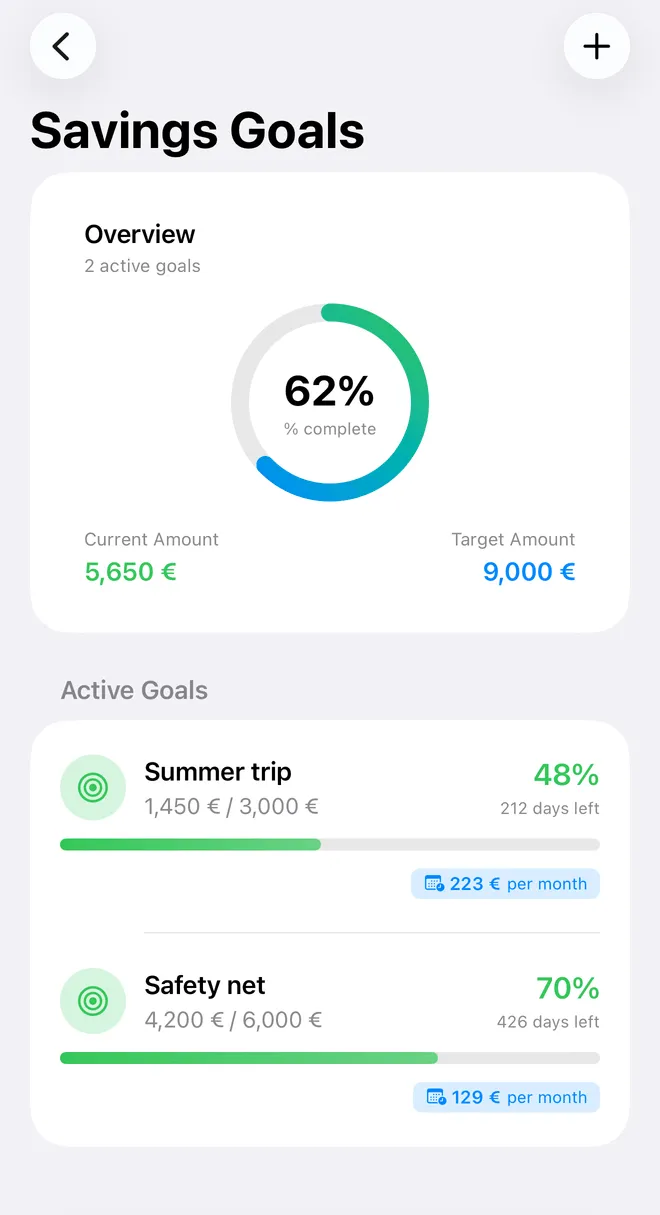 FinaPrism’s Savings Goals screen (demo data).
To find the money each month, budgets (free as well) show what’s left in each envelope. No ads, no ad tracking.