A monthly budget isn’t a list of things you’re not allowed to do. It’s a decision you make before the money goes: how much for the rent, how much for the food shop, how much for yourself, how much to put aside. Without that decision, the month makes it for you, and a week before payday you discover there’s almost nothing left.
Here’s how to make a monthly budget that lasts. It takes an hour the first time, then ten minutes a week, and it comes down to four steps.
Step 1: start from what actually comes in
Write down what you receive each month: your take-home pay, after tax and deductions, plus any pension, benefits or income from a side job.
If your income varies (self-employed, bonuses, overtime), don’t start from the average. Start from your lowest month of the last six: a budget built on a good month breaks at the first lean one. Anything that comes in on top is a bonus, and you decide where it goes when it arrives.
Step 2: list your fixed costs
Fixed costs come round every month, for an amount you know in advance, and you can’t cut them overnight: rent or mortgage, gas and electricity, insurance, broadband and mobile, your travel pass, any tax you pay in monthly instalments, subscriptions.
The easiest way is to take your last three bank statements and highlight everything that repeats. There are two traps to avoid:
- annual costs: car insurance of €480 paid in March works out at €40 a month, even in the months when nothing goes out. Convert every annual cost to a monthly figure, or it will land in a month that wasn’t planned for it;
- small subscriptions: €4.99 here, €9.99 there, they slip past unnoticed on a statement. They count too.
Step 3: give every variable expense its own envelope
Whatever is left after your fixed costs is shared out into envelopes: groceries, going out, health, clothes, leisure, gifts, the unexpected. An envelope is a spending limit for the month.
Two rules make envelopes workable:
- Start from what you spend today, statements in hand, not from an ideal. If your food shop costs €450 a month, a €300 envelope will be blown by the second week, and you’ll give up on the budget with it. Cut by 10% in the first month, not by 30%.
- Pay yourself first. If saving is “whatever’s left at the end”, there’s usually nothing left. Set up a standing order to your savings account for the day your salary lands, even for a small amount: it’s an envelope like any other, simply filled before the rest.
Here’s an example of what it looks like: a single person with take-home pay of €2,400 a month. The figures are in euros, but the method works the same in any currency.
| Item | Amount |
|---|---|
| Take-home pay | €2,400 |
| Rent and service charges | €750 |
| Gas and electricity | €80 |
| Home insurance | €15 |
| Broadband and mobile | €45 |
| Monthly travel pass | €75 |
| Car insurance (€480 a year) | €40 |
| Subscriptions (music, streaming, cloud storage) | €30 |
| Total fixed costs | €1,035 |
| Savings, transferred on payday | €200 |
| Groceries | €380 |
| Restaurants and going out | €150 |
| Leisure | €80 |
| Clothes | €60 |
| Health | €40 |
| Gifts | €40 |
| Unexpected costs | €100 |
| Left to allocate | €315 |
The €315 at the bottom isn’t “spare”. Left without a job to do, it melts away and you never quite know where it went. Give it a destination: say, another €100 into savings and the rest into the envelope that overflows most often. The aim is for every euro of your income to have a place, and for the bottom line to come out at zero.
Step 4: check in every week, adjust every month
A budget you only look at once the month is over tells you what happened; it doesn’t help you decide. Take ten minutes a week, always on the same day, to compare what you’ve spent with each envelope:
- an envelope that’s 70% gone by the middle of the month is a sign to ease off;
- an envelope that overflows is topped up from another spending envelope, not from your savings, so the budget still adds up.
At the end of the month, adjust. An envelope that overflows three months running was set too low: raise it and lower another. One you never dip into can make way for another. After two or three months, the budget finally looks like your life, and it becomes easy to stick to.
Four mistakes that make people give up on a monthly budget
- Envelopes that are too tight from the start: the first bad week is enough to put you off.
- Forgetting annual and one-off costs: back-to-school spending, tax bills, holidays, car repairs. An “unexpected” envelope, or a little set aside each month, absorbs them.
- Not counting the small stuff: coffees, takeaways and online shopping often make the difference between staying within budget and going over.
- Stopping after one bad month. Going over doesn’t mean the method has failed: it tells you which envelope to adjust.
And with FinaPrism
Everything above works on paper or in a spreadsheet. FinaPrism turns it into a budget planner on your iPhone:
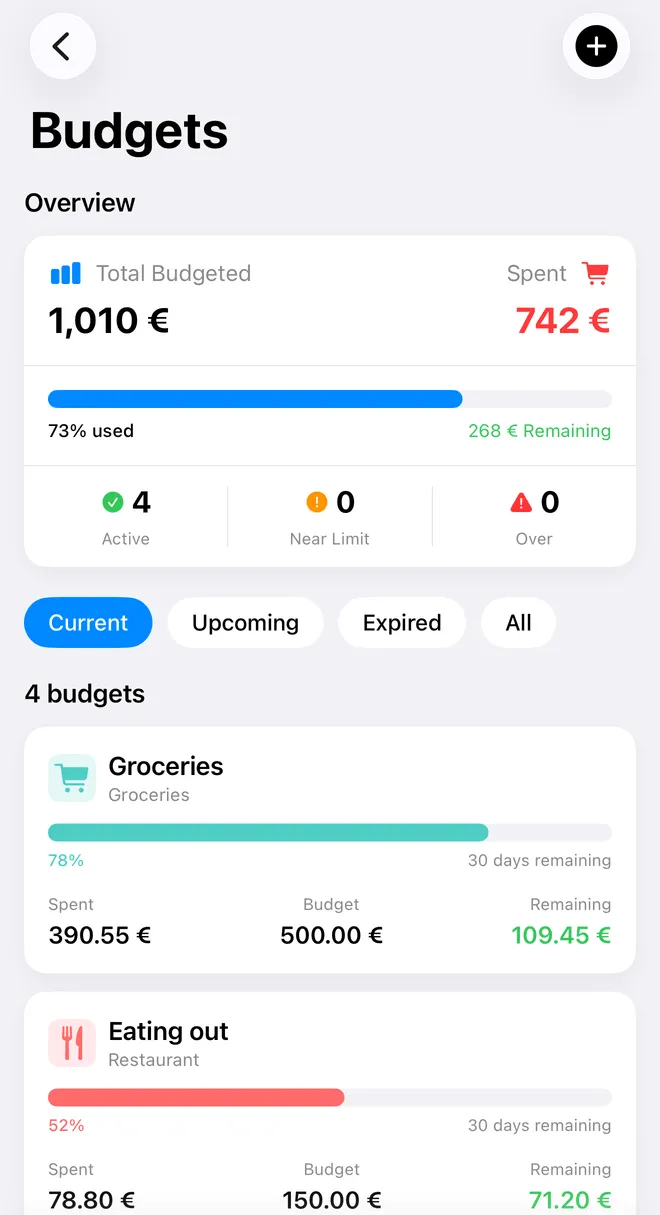 FinaPrism’s Budgets screen (demo data).
- a budget for each category, with an alert when your spending reaches the threshold you’ve set, and the progress of every envelope at a glance, all in the free version;
- statement import (Premium, with a 7-day free trial): a PDF or CSV statement, a photo or a screenshot, and the transactions are added to your accounts, without connecting your bank.
Your accounts stay yours: no bank connection, no ads, no trackers.