Groceries are often the biggest variable expense of the month, and the one that comes round most often: two or three trips a week, a loaf of bread here, a big shop to fill the fridge there. Each receipt looks reasonable; it’s the sum that comes as a surprise.
You’ll find figures everywhere for a grocery budget “for two” or “for a family of four”. They don’t tell you much: depending on where you live, how old the children are, and whether lunch is eaten at school or at work, one household can easily spend twice as much as another of the same size. The only useful figure is yours. Here’s how to find it, then bring it down, in six steps.
1. Measure what you really spend
Go back over your last three months and add up all your grocery spending: the supermarket, but also the market, the bakery, click and collect or delivery, the evening top-up at the corner shop on the way home. Divide by three.
An example:
| Month | Groceries |
|---|---|
| August | €512 |
| September | €468 |
| October | €547 |
| Average | €509 |
That’s your starting point, not a verdict. The quick trips often count for more than you’d think: how to spot them is in Small daily expenses: how little amounts add up to big totals.
2. Set a budget for the month, then for the week
Aim a little below your average, not at half of it: a realistic target is one you keep, a heroic one gets dropped after ten days. In the example, €460 a month, or about €106 a week (€460 divided by the 4.33 weeks in a month).
The weekly budget is the one you’ll actually use: it’s week by week that you decide what to buy. Keep a small margin for the unexpected: guests, a birthday. Big festive meals, though, are planned separately: in December, they belong in the Christmas budget.
3. Plan your meals, then write the list
- Look at what you already have first, in the fridge, the freezer and the cupboards: the list starts with what needs using up.
- Plan the week’s meals, at least the evening meals. No need for a menu down to the gram: knowing it’s pasta on Tuesday and soup on Thursday is enough to buy the right amounts.
- Write the list in the order of the shop, aisle by aisle. Less doubling back down the aisles means fewer chances to add things you hadn’t planned.
4. Compare the unit price, not the pack price
- The unit price, per kilo, per litre or per 100 g, is on the shelf label, in small print near the main price. That’s the figure that lets you compare two pack sizes, two brands, loose and pre-packed. Check that both labels use the same unit before you compare.
- Own-brand products often cost less for something very similar: try them on a few basics, and keep the ones you like.
- Multi-buys and offers only save money if you use everything before its date. Three for the price of two, with one ending up in the bin, is the normal price.
- Seasonal fruit and vegetables are usually cheaper, and taste better.
5. Stay away from what wasn’t on the list
- Don’t shop hungry: everything looks essential.
- Watch out for the end-of-aisle displays and the checkout: that’s where the impulse buys are placed.
- Shop less often. Every top-up shop, even “just for milk”, is a chance to buy more than you planned. One big list a week often costs less than four small ones.
- Click and collect or delivery show the basket total before you pay: handy for taking something out, as long as you count the charges.
6. Throw less away
Whatever ends up in the bin is paid for twice: once when you buy it, then again when you replace it. Put what’s closest to its date at the front, freeze what you won’t eat in time, and plan a “leftovers” meal once a week. And tell the two dates apart: “use by” is a safety limit, while “best before” is about quality: the food is usually still fine afterwards, and what it loses is mainly taste or texture.
Review it every month
At the end of the month, compare the total with your budget. Over? Look at where it went: the number of trips, one aisle in particular, the meals you made up on the spot. Under? Put the difference aside rather than spending it the following month. The method for turning each type of spending into an envelope: How to make a monthly budget: a simple 4-step method.
And with FinaPrism
- Measure (step 1): in Tools, Transaction Search filters your spending by category and by period, and shows the total. Analytics also ranks your biggest spending by merchant.
- Stick to the budget (step 2): a budget on the Groceries category, with an alert when it reaches the threshold you’ve chosen (80% by default).
- Write the list (step 3): the Groceries tool, also in Tools, puts each item in its aisle, in the order of a walk round the shop, with the chilled aisles and frozen food last. A quantity with its unit, a brand, a photo if needed; in the shop, one tap puts the item in the cart.
- Log every trip: the “Quick add” widget on your Home Screen, or Siri.
All of this is free, with one shopping list.
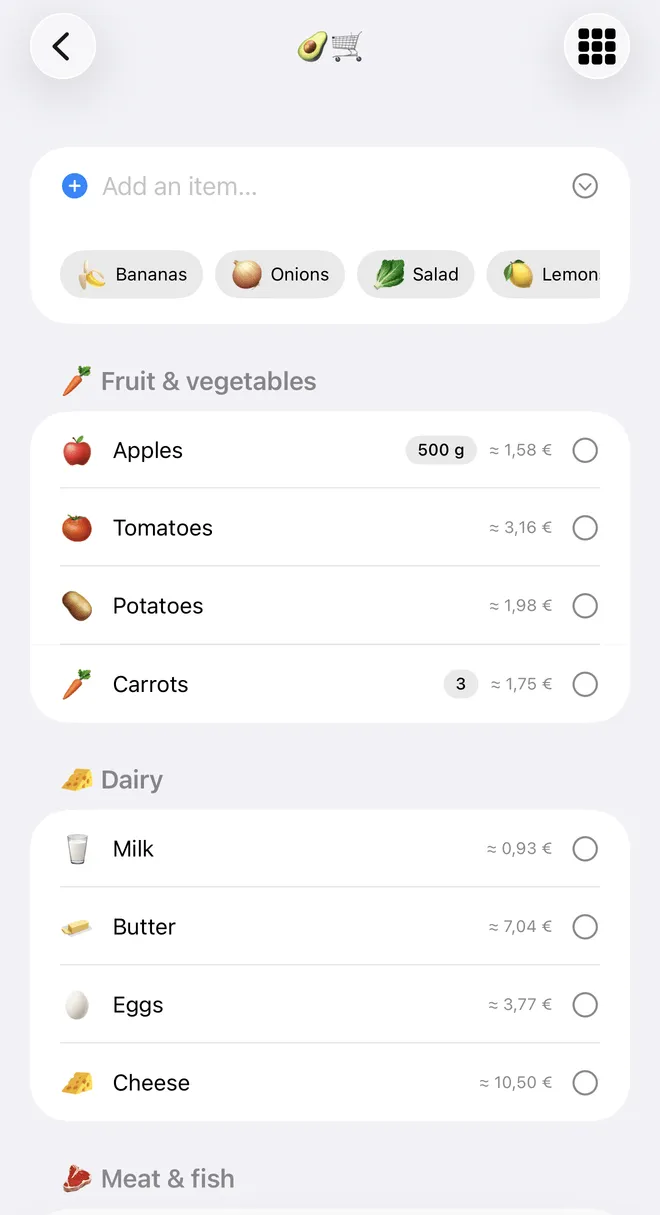 FinaPrism’s shopping list; the estimated prices come with Premium (demo data).
With Premium (7-day free trial), the list estimates what your basket will cost: a price for each item still to get, and a total, based first on your own analysed receipts, then, for items they don’t cover, on the average price recorded in your country. The estimate shows where its prices come from and how many items don’t have one yet. Premium also gives you several lists, and the Elite plan adds Household sharing: a shared list that the members you choose add to and tick off in real time. No bank connection, no ads, no ad tracking.