Budgeting line by line takes time. The 50/30/20 rule offers a shortcut: split your income into three parts, and keep an eye on just three numbers. It was popularised by Elizabeth Warren and Amelia Warren Tyagi in their book All Your Worth (2005), and it’s still one of the simplest ways to get started.
How the 50/30/20 rule works
Start from your take-home pay, the net income that actually lands in your account each month, and split it like this:
- 50% for needs: what you have to pay whatever happens;
- 30% for wants: what makes life enjoyable, but you could live without;
- 20% for savings: what you put aside, or use to pay off debt faster.
On take-home pay of €2,400 a month (the example is in euros, but the percentages work the same in any currency), that works out as:
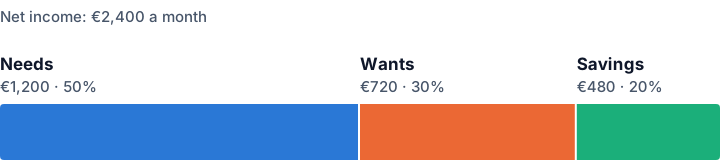 The 50/30/20 rule applied to €2,400 of take-home pay.
| Part | Percentage | Amount a month |
|---|---|---|
| Needs | 50% | €1,200 |
| Wants | 30% | €720 |
| Savings | 20% | €480 |
Needs or wants: where each expense goes
The whole value of the method lies in this sorting. A rule of thumb: a need is an expense you couldn’t stop next month without serious consequences.
| Needs (50%) | Wants (30%) |
|---|---|
| Rent or mortgage payments | Eating out, takeaways, nights out |
| Gas, electricity, water | Holidays and weekends away |
| Basic groceries | Streaming, music and gaming subscriptions |
| Getting to work | Clothes beyond the essentials |
| Compulsory insurance | Leisure, sports clubs, hobbies |
| Broadband and mobile | Gadgets and homeware |
| Healthcare, childcare | Gifts |
| Minimum debt repayments |
There are plenty of grey areas, and that’s normal. The weekly shop is a need; treats from the deli are a want. A mobile contract is a need; the latest phone is a want. Decide once, write your rule down, and stick to it: being consistent matters more than exactly where the line falls.
Start by measuring your current split
Before aiming for 50/30/20, see where you stand today. Take your last three months of statements, sort each expense into needs, wants or savings, and work out the three percentages. As an example:
| Part | Today | Target | Gap |
|---|---|---|---|
| Needs | €1,350 (56%) | €1,200 (50%) | +€150 |
| Wants | €850 (35%) | €720 (30%) | +€130 |
| Savings | €200 (8%) | €480 (20%) | −€280 |
The gap tells you where to act. Here, wants are €130 over: that’s the first lever, and the quickest to pull. Needs come down more slowly (shopping around for insurance, moving to a cheaper mobile contract).
When to adapt the 50/30/20 budget
The 50/30/20 rule is a starting point, not a standard. It doesn’t always work as it stands:
- Expensive housing. In a big city, rent alone can take more than 40% of your income. A 60/30/10 or 60/20/20 split is more realistic; what matters is that savings don’t fall to zero.
- Low income. When needs take 70% or more, start by saving 5%, then add a percentage point whenever you can. A small amount saved regularly beats a target you abandon.
- Debts to pay off. Minimum repayments go under needs; anything you pay off on top can come out of the 20%.
- Irregular income. Work out the percentages on your lowest month, and put aside whatever comes in above it in the good months.
Once you’ve found your split, the 4-step monthly budget turns it into spending envelopes, and taking stock of your subscriptions is often the quickest way to bring wants back down to 30%.
And with FinaPrism
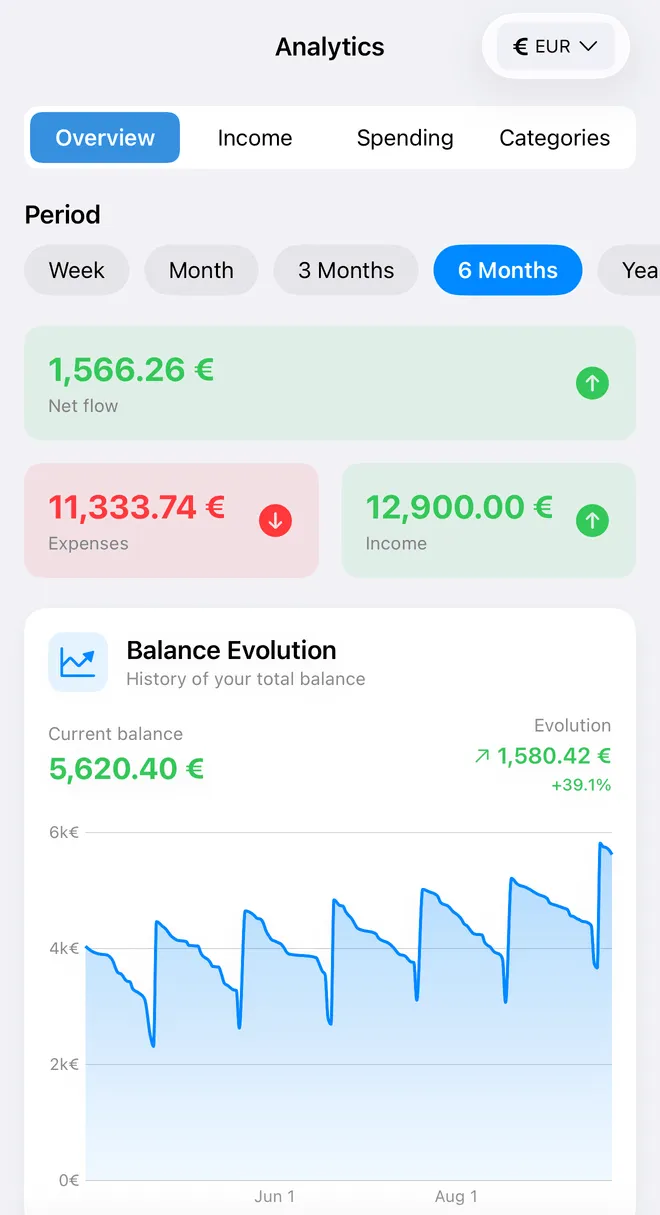 FinaPrism’s Analytics tab (demo data).
- The Analytics tab shows your income, your spending and your savings rate over the period you choose: enough to measure your current split at a glance. It’s free.
- Tags let you mark each expense as a “need” or a “want”, and a budget can follow a tag instead of a category: set a €1,200 “Needs” budget and a €720 “Wants” budget (50% and 30% of €2,400), and the rule is tracked automatically, with an alert when you reach your threshold, before you go over. Budgets and tags are free.
- Statement import (Premium, with a 7-day free trial) adds your transactions from a PDF or CSV statement, a photo or a screenshot, without connecting your bank.
No ads, no trackers.