There’s no single right way to split bills as a couple. There’s the one that feels fair to both of you, and that is still easy to keep up six months on. Most couples use one of these three methods, or a mix of them.
1. Fifty-fifty
Each of you pays half of the shared costs: rent, the food shop, energy, insurance, evenings out together. The rest of your income, you each manage as you see fit.
Who’s it for? Couples with similar incomes. It’s the easiest method to explain and to keep track of.
The catch. When incomes are far apart, splitting 50/50 weighs far more heavily on the smaller salary. Take an example (in euros here, but the maths is the same in any currency): incomes of €3,000 and €1,800, and €1,500 of shared costs. At €750 each, one partner keeps €2,250 for themselves, the other €1,050. Both pay “the same”, but not with the same effort.
2. In proportion to income
Each of you contributes to shared costs in proportion to what you earn. Back to the example: €3,000 and €1,800, so €4,800 between you. The first partner brings in 62.5% of the household income, the second 37.5%. On €1,500 of shared costs:
| Income | Share | Contribution | Left for yourself | |
|---|---|---|---|---|
| Partner A | €3,000 | 62.5% | €937.50 | €2,062.50 |
| Partner B | €1,800 | 37.5% | €562.50 | €1,237.50 |
Each of you puts the same share of your income, here 31.25%, into your life together.
Who’s it for? Couples with different incomes who each want to keep real independence.
The catch. You have to recalculate whenever an income changes (a new job, going part-time, parental leave), and agree on what counts as “shared”: holidays? one partner’s car?
3. Everything pooled
All your income goes into one pot, and all your spending comes out of it. Many couples who choose this method still give each partner some personal spending money, the same amount for both, to spend without having to justify it.
Who’s it for? Settled couples with plans in common, who see themselves as a single financial household.
The catch. You need to agree on priorities. Without that personal money, every purchase becomes a discussion.
The joint account: a tool, not a method
Whichever method you choose, a joint account makes life simpler: each of you pays your share into it at the start of the month, and shared costs go out of it. The direct debits for rent, energy and insurance come out of the joint account, and its card pays for the food shop.
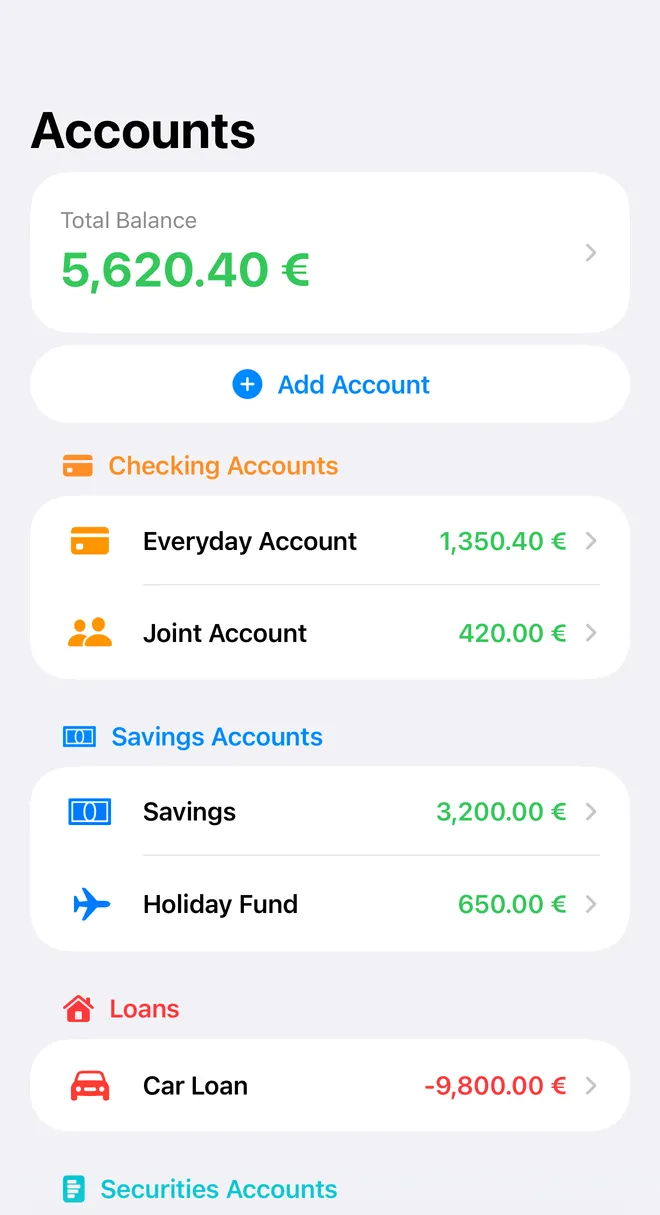 A joint account alongside personal accounts, in FinaPrism (demo data).
Whatever goes through the joint account is your list of shared costs. Whatever doesn’t stays personal. Arguments rarely come from the amounts, more often from the grey areas: better to write the list down once than to renegotiate it every month.
How to split bills as a couple, day to day
- List your shared costs and their monthly amount, with annual costs converted to a monthly figure (the method is explained in How to make a monthly budget).
- Choose your method and work out each person’s share.
- Set up standing orders into the joint account for the day after payday.
- Agree a threshold above which a shared purchase is decided together (say €150), and below which each of you is free.
- Hold a fifteen-minute check-in each month: what was spent, what went over, what’s coming up (birthdays, holidays, repairs).
And make sure you each keep a share of your own. A couples budget that leaves no room for individual freedom doesn’t last long.
And with FinaPrism
In FinaPrism, each of you can keep your accounts and budgets on your own iPhone, for free. To manage them together, Household sharing (Elite plan) brings together up to six people:
- you choose, account by account, what becomes shared: the joint account for your partner, a “Groceries” budget for the whole household, and your personal accounts for you alone;
- nothing is shared by default, and you can withdraw a share whenever you like;
- each of you sees the transactions on shared accounts, and a shared budget counts the spending on those accounts, whoever entered it, but never the spending on your personal accounts.
No bank connection, no ads, no trackers: your accounts are visible only to the people you’ve chosen.